Most wellness practitioners never choose a business model. They just start seeing clients, and the schedule fills however it fills. A few years in, they're running a high-volume practice without ever deciding to.
There's another option. A boutique practice is built for depth, not volume.
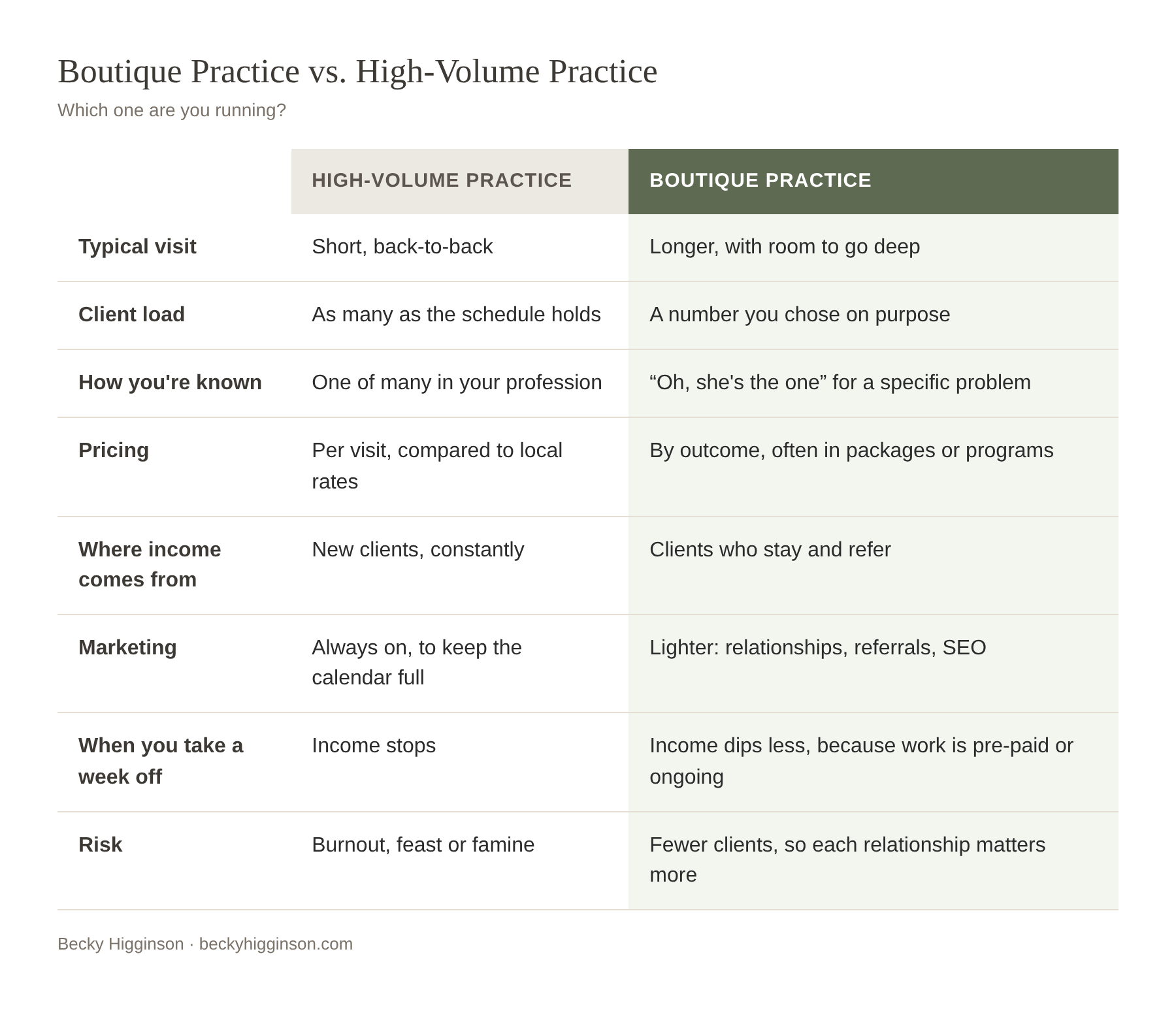
Here's how the two compare, so you can see which one you're running and which one you actually want.
What is a high-volume practice?
A high-volume practice grows by adding appointments. More clients means more sessions, which means more money. Visits are often short, prices are set by what everyone else in town charges, and the calendar needs constant refilling.
This model works for some people. It can be a good fit if you love a fast pace, have a team to support you, or work inside a clinic that handles the business side.
But it has a ceiling. You only have so many hours in a day and so much energy in your body. When you hit that ceiling, the only ways to earn more are to work longer or raise prices without changing anything else.
What is a boutique practice?
A boutique practice grows by deepening the work. You choose how many clients you can serve well, you're known for something specific, and your pricing reflects the problem you solve, not the hour you spend.
Instead of asking "How do I fit in more appointments?", a boutique practice asks "How can I create more value without adding more appointments?"
Signs you're running a high-volume practice (even if you didn't mean to)
You're booked solid one month and scrambling the next.
A cancellation or a sick day hits your income right away.
You've thought about raising prices but worry clients will leave for someone cheaper.
You're too tired to market when you're full, then panic when you're not.
You can't remember the last time you had space to think about your business.
None of this means you're doing anything wrong. It means the model has a ceiling, and you've found it.
Why "just see fewer clients" doesn't work
The most common mistake is cutting hours without changing anything else. That's not a boutique practice. It's the same practice with less income.
To make the switch, the whole system has to shift together: what you're known for, how you package your work, how you price it, and how clients find you. That's why it's a business design problem, not a marketing problem.
Busy ≠ working
A full calendar isn't proof that your business is healthy. The real questions are: Are you earning what you need? Do you have time off? Do you still love the work?
If the answers are no, a busier calendar won't fix it. A different design might.
Curious which model you're really running? Start with a free Practice Assessment.
Want to stay in the know?
Weeklyish Musings goes out roughly once a week with reflections on building a business + life that doesn't ask you to extract from yourself to survive.